Who Warns the Fans? Artist Impersonation, Platform Liability, and the New Responsibility of Digital Media

When fan communities become the first line of defense against scams, who is accountable for the systems that allow deception to circulate?
Made-Sick | November 9, 2026
Media accountability · Artist rights · Consumer protection · Digital culture
From Narrative Control to Consumer Protection
In our previous article, The Evolution of Hip-Hop Journalism: Narrative Control, Platform Metrics, and the Battle for Cultural Authority, we examined how authority shifted from traditional music publications to independent commentators, livestreamers, algorithms, and audiences.
The central argument was that visibility and credibility are not interchangeable.
But there is another dimension to this transformation: What happens when control over information becomes a question of consumer safety rather than cultural influence?
When an artist's identity is used to promote an allegedly fraudulent offer, who must warn the audience? The platform hosting the activity? The artist's management or publicity representatives? The journalists documenting it? Or the fans who discover it?
Recent litigation against Meta and other social media companies makes these questions increasingly relevant.
A warning circulating through the independent British artist Ren's community offers a case study in the limitations of relying on audiences to protect themselves.

1. The Ren Fan Warning: When Communities Become Their Own Consumer Watchdogs
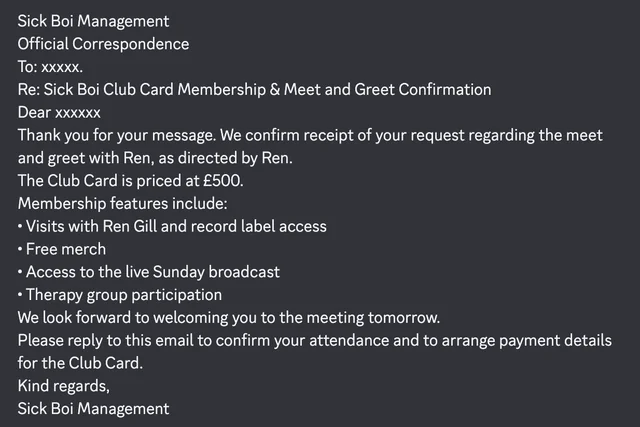
On November 9, 2026, a post in Reddit's r/ren community warned about an alleged offer from an entity calling itself "Sick Boi Management."
According to the post, the entity was offering a £500 membership with promises including a meet-and-greet at an allegedly fictitious event.
The poster also reported that someone on Patreon had tried to publish a warning in the subreddit but was blocked, and that Ren's team had reportedly been made aware of the situation.
These details come from a community report. Made-Sick has not independently verified the alleged solicitation, the circumstances of the earlier moderation decision, or whether Ren's representatives received and acknowledged the report.
That distinction is essential. A legitimate concern does not become a verified finding simply because it circulates among fans.
Nevertheless, the reported sequence raises an important structural issue.
A member of the audience identifies a suspected threat. Another attempts to notify the community. The warning reportedly encounters a moderation obstacle. A subsequent community post becomes the means of public disclosure.
If professional verification is unavailable, fans must then decide whether the message is authentic, whether the warning is trustworthy, and whether the artist has authorized the offer.
The audience has become the reporter, investigator, distributor, and potential victim.
That arrangement may reflect a committed community. It should not be mistaken for a complete consumer-protection system.
2. The Meta Litigation: Platforms Are More Than Passive Hosts
For decades, technology companies have relied in part on Section 230 of the US Communications Decency Act to defend against liability arising from third-party content.
That protection remains significant. But litigation increasingly examines conduct beyond the mere hosting of user-generated speech.
On March 25, 2026, a Los Angeles jury found Meta and YouTube liable in a case involving allegedly addictive platform design and harm to a young user. The jury awarded $6 million in compensatory and punitive damages. Both companies disputed the verdict.
The preceding day, a New Mexico jury found Meta liable under state consumer-protection law for misleading representations and practices concerning child safety, imposing $375 million in civil penalties.
In August 2026, a New Mexico court entered a further judgment ordering $567 million in additional remedies and imposing court-supervised changes to Meta's platforms. Together, those amounts reached $942 million, with the judgment remaining subject to further legal proceedings.
Also in August, the Ninth Circuit allowed thousands of social media addiction lawsuits to proceed past a particular Section 230 immunity challenge.
These cases do not establish that social platforms are automatically responsible for every harmful post.
They demonstrate something more specific: courts are examining whether platform design, company representations, and failures to warn about particular risks can create legal exposure separate from the content produced by users.
This distinction matters to journalism because the platform is no longer merely a channel distributing the story.
Its systems may influence which warnings become visible, which claims gain credibility through repeated exposure, and how easily harmful activity can be reported.

3. The Impersonation Cases Reveal the Limits of Accountability
The legal picture is not uniformly favorable to people harmed by online deception.
In Suddeth v. Meta Platforms, financial professionals alleged that fraudsters impersonated them through Meta's services to promote an investment scheme.
On August 13, 2026, a federal judge dismissed their complaint, finding that Section 230 protected Meta against the claims as presented. The plaintiffs were granted another opportunity to amend.
The decision demonstrates why artist impersonation cannot simply be treated as legally equivalent to harmful product design.
Courts must distinguish between content created by scammers and misconduct attributable to the platform itself.
Meanwhile, an April 2026 lawsuit filed by the Consumer Federation of America alleged that Meta profited from fraudulent advertising while misleading consumers about its safety practices. Meta disputed those allegations.
Meta has also taken legal action against scam advertisers, including operations using celebrity imagery and fabricated endorsements.
These developments reveal a complicated reality: platforms can be targets of fraud, operators of fraud-prevention systems, defendants in consumer-protection litigation, and distributors of the advertising infrastructure exploited by scammers.
The appropriate question is not whether platforms are responsible for every unlawful act committed through their services.
It is what duties arise from their own knowledge, commercial practices, safety representations, and handling of credible reports.
4. Artist Management Cannot Delegate Authenticity to the Audience
The responsibilities of artists and their professional representatives require a separate analysis.
Artists are vulnerable to impersonation precisely because audiences recognize their names, visual identities, work, and community relationships.
A fraudulent offer can exploit those relationships without the artist's involvement or permission.
There is no general rule making an artist legally responsible whenever someone impersonates them. Nor does an unverified allegation that management was notified establish negligence or wrongdoing.
But a practical responsibility remains.
Artist representatives are usually better positioned than fans to confirm whether a membership program, merchandise offer, meet-and-greet, charitable solicitation, or event is genuinely authorized.
That makes official verification an important element of responsible audience communication.
A useful public response should identify the disputed offer, state whether it is authorized, direct consumers to trustworthy official information, and explain how suspicious solicitations can be reported.
It should avoid exposing complainants or circulating unnecessary personal information.
The objective is not to require artists to monitor every conversation about them.
It is to ensure that fans are not left attempting to authenticate commercial offers without access to the party capable of providing authoritative confirmation.
5. The UK Dimension: Fraud and Online Safety
Because the Ren warning concerns a British artist and an offer denominated in pounds, UK online safety regulation provides additional context.
The UK's Online Safety Act imposes duties on covered online services to assess and reduce risks associated with illegal content, including relevant fraud offences.
Ofcom oversees compliance with these obligations.
The Act does not automatically make every music manager, fan forum, or artist responsible for every fraudulent solicitation appearing online. Application depends on the service, the conduct, and the relevant legal duties.
Nevertheless, the legislation reflects an important regulatory principle: reducing foreseeable online risks cannot always be left to individual users.
For an international music community, this creates a further complication. The alleged operator, artist, platform, consumer, and payment provider may all be located in different jurisdictions.
That is precisely why public verification, accurate reporting, and evidence preservation matter.
6. From Hip-Hop Journalism to Platform Journalism: Who Controls the Warning?
Our earlier article examined how DJ Akademiks, Scru Face Jean, and other independent commentators demonstrate the changing relationship between cultural influence, audience participation, and editorial authority.
The lessons extend beyond hip-hop.
In the print era, editors decided which stories reached readers. In the creator economy, platform recommendation systems, moderation tools, community administrators, and influencers participate in distributing information.
That change expands access to public discussion, but it also complicates accountability.
A fan may have firsthand evidence of a deceptive solicitation yet lack access to an official representative.
A moderator may remove a warning because it resembles prohibited promotional material, contains private information, or triggers automated controls.
A commentator may amplify the warning without verifying its claims.
A platform may distribute questionable promotional material while a corrective post receives limited visibility.
These possibilities illustrate an important distinction between controlling distribution and accepting responsibility for the consequences of distribution.
Not every moderation error is evidence of misconduct. Not every unverified warning should be circulated without editorial review.
But when systems can restrict warnings while potentially harmful claims continue to circulate, the public deserves an understandable reporting and review process.
The responsibility of journalism is to document that process, verify what can be verified, and distinguish genuine institutional failures from assumptions about motive.
7. Fans Are Participants, Not an Unpaid Fraud Department
Fan communities provide a form of social infrastructure for independent artists.
They organize information, identify suspicious activity, explain developments, and help newcomers distinguish legitimate channels from impostors.
These contributions have value.
But communities also operate through trust, emotional investment, and unequal access to information.
A person offering money for special access to an artist may believe they are supporting creative work or strengthening a meaningful connection with a community.
Fraudsters can exploit that relationship by presenting payment as a condition of belonging, recognition, or proximity.
This is not evidence that every paid membership is exploitative or that any particular audience is unusually vulnerable.
It is a reason to recognize that financial deception can involve more than a misleading price.
It may involve an unauthorized claim to authority and an attempt to convert community trust into money.
Fans can report suspicious activity. They can preserve communications and warn others responsibly.
They should not have to assume the investigative, legal, or verification responsibilities of platforms and professional representatives.
8. What Independent Media Should Do Differently
Made-Sick's approach to independent publishing rests on an important boundary: documenting harm is not the same as declaring someone responsible for it.
In an impersonation investigation, meaningful accountability requires separating several questions.
Was an offer actually made? Is there primary evidence of the solicitation? Does the sender possess authorization? Which service distributed it? Was a report submitted, and what response followed? Has the affected artist or organization issued a verifiable statement?
Those questions help distinguish confirmed facts from reports, allegations, and unresolved claims.
They also establish the basis for responsible follow-up coverage.
Corrections and updates should remain visible. Sources should be attributed. Private information should be protected. Affected parties should have a reasonable opportunity to respond.
This is particularly important when a story crosses national borders, involves competing intellectual-property claims, or concerns a creator's commercial identity.
Independent media does not need the resources of a major newsroom to adopt these standards.
It needs transparent methods and a willingness to correct the record.
Conclusion: Cultural Authority Comes With Responsibility
The evolution of music journalism has expanded who can tell the story.
The lawsuits involving Meta and other social media companies are testing how responsibility should be assigned when the systems distributing those stories contribute to harmful outcomes.
The reported Ren impersonation warning brings a smaller but related problem into focus.
If fans are trusted to promote an artist's work, buy merchandise, support independent releases, and sustain online communities, they deserve access to reliable information when someone attempts to exploit that trust.
Platforms have responsibilities concerning their own systems. Professional representatives can clarify what their organizations authorize. Journalists must verify and contextualize. Fans can participate without being made responsible for the entire process.
These are different obligations, and they should not be confused.
The next evolution of independent media is not simply about giving more people a microphone.
It is about establishing whether the people and institutions controlling visibility can be held accountable for the way important information reaches the public.
The question is no longer only who gets to tell the story. It is who makes sure the warning can be heard—and who has the authority to confirm that it is true.
Sources and Further Reading
Previous Made-Sick reporting
Community reporting
US litigation and reporting
- New Mexico Department of Justice — March 24, 2026 jury verdict
- New Mexico Department of Justice — August 7, 2026 judgment
- Los Angeles Times — March 25, 2026 California verdict
- CBS News — August 10, 2026 appeals court ruling
- US District Court — Suddeth v. Meta, August 13, 2026
- Reuters — Consumer watchdog lawsuit over Meta scam advertising, April 21, 2026
- Meta — Legal action against scam advertisers, February 2026
UK regulation
Editorial note: This article discusses reported events, public court decisions, allegations, and regulatory obligations. The Reddit account has not been independently substantiated by Made-Sick. References to litigation do not imply liability on the part of Ren, his representatives, Reddit, or any unidentified person associated with the alleged membership offer. This article is independent media analysis, not legal advice.
#ArtistRights #MediaAccountability #PlatformLiability #ConsumerProtection #MusicIndustry #DigitalMedia #MediaLiteracy #OnlineSafety #IndependentJournalism #MadeSick

